Vertical Axis Wind Turbines (VAWTs). They’re the sleek, sometimes sculptural, cousins of the more familiar Horizontal Axis Wind Turbines (HAWTs) that dominate wind farms. But can innovation truly unlock their potential, making them the most efficient vertical axis wind turbine option for energy generation? Let’s delve into the world of VAWT design and see what the future holds.
Understanding VAWTs, The Basics
Before we chase efficiency gains, let’s ground ourselves in the fundamentals. Unlike HAWTs, which resemble airplane propellers and must constantly orient themselves to face the wind, VAWTs have their rotor shaft oriented vertically. This crucial difference offers several advantages. VAWTs can accept wind from any direction, simplifying installation and eliminating the need for yaw mechanisms. They also house the generator and gearbox at ground level, easing maintenance.
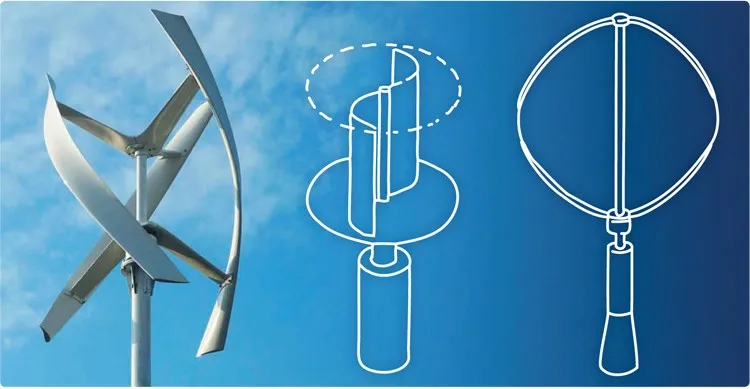
But if VAWTs are so convenient, why aren’t they everywhere? The answer lies in their historical performance. Traditional VAWT designs, particularly the Darrieus type (think eggbeater), have struggled to match the energy capture rates of HAWTs. They’ve been plagued by issues like lower starting torque and structural fatigue. Could we change that?
The Quest for a More Efficient Vertical Axis Wind Turbine
The pursuit of a more efficient vertical axis wind turbine is driven by the desire to tap into the benefits of VAWTs without sacrificing power output. This quest has led to a wave of innovative designs and modifications, each aiming to overcome the limitations of earlier models.
One promising avenue is blade design. Traditional Darrieus turbines use simple, curved blades. However, advanced airfoil shapes, inspired by airplane wing design, can significantly improve aerodynamic performance. These optimized airfoils generate more lift and reduce drag, translating to higher rotational speeds and greater energy production.
Another area of focus is variable pitch control. Imagine blades that can adjust their angle of attack depending on wind conditions. This active control system allows the turbine to optimize its performance across a wider range of wind speeds, preventing stalling and maximizing energy capture. This is particularly useful in gusty or turbulent environments.
Beyond blade design, researchers are also looking at innovative rotor configurations. Helical VAWTs, with blades that twist along the vertical axis, offer smoother torque output and reduced noise compared to traditional Darrieus designs. Other concepts include shrouded VAWTs, which use a duct to concentrate wind flow onto the rotor, further boosting performance.
Cutting-Edge Designs, Case Studies
Several companies and research institutions are pushing the boundaries of VAWT technology. Let’s look at a few examples.
One company is developing a VAWT with a unique “omni-directional” design. This turbine features multiple sets of blades arranged around a central axis, allowing it to capture wind from virtually any direction with maximum efficiency. Another company is using advanced computational fluid dynamics (CFD) to optimize blade shapes and rotor configurations, resulting in a VAWT with significantly improved power output.
Researchers at universities are also making significant contributions. They’re investigating the use of new materials, such as lightweight composites, to reduce the weight of VAWT blades and improve their structural integrity. They’re also developing sophisticated control algorithms to optimize turbine performance in real-time.
Challenges and Future Directions
Despite the progress, challenges remain. VAWTs still face skepticism from some in the energy industry, and the economics of VAWT projects need to be carefully considered. Manufacturing costs can be higher compared to HAWTs, and the long-term reliability of advanced VAWT designs needs to be proven in real-world conditions.
However, the future looks bright. As technology advances and manufacturing processes become more efficient, the cost of VAWTs is likely to decrease. Continued research and development will further improve their performance and reliability. The most efficient vertical axis wind turbines of tomorrow could play a significant role in meeting our growing energy needs, particularly in urban environments and distributed generation applications.
Imagine a world where sleek, silent VAWTs are integrated into building designs, silently generating clean energy for homes and businesses. That future may be closer than we think.